
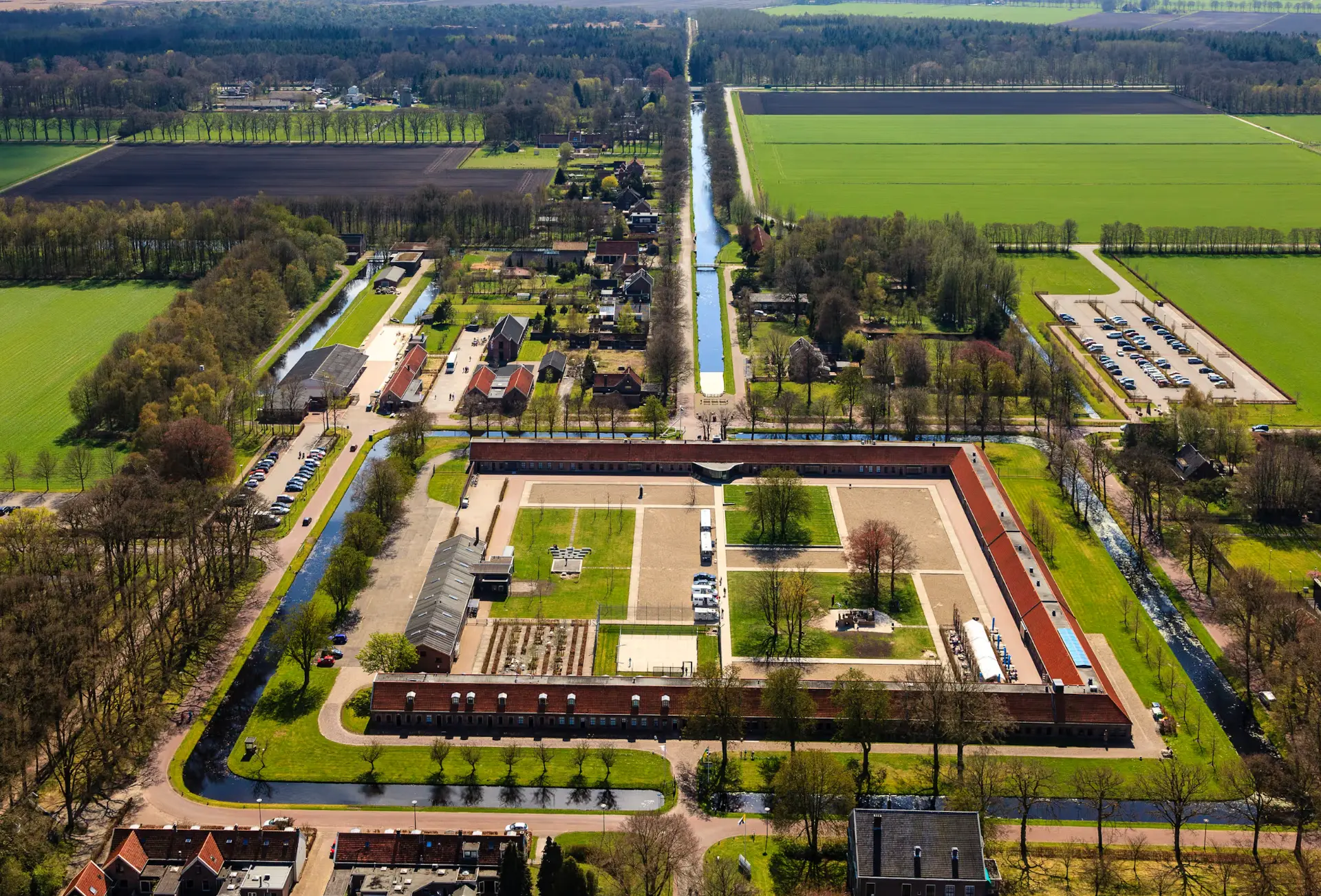
General Johannes van den Bosch built Veenhuizen on behalf of the state as a refuge for orphans, the poor, and vagrants. Three large institutions, its own infrastructure of canals and avenues, and a community that had to be completely self-sufficient.
Later, management was taken over by the Dutch state, and Veenhuizen grew into a penal colony. Vagrancy and begging were punishable; whoever was arrested was sent to Veenhuizen. Until around 1980, it was a closed area where you were only allowed if you had business there.
Officials lived in the houses with edifying sayings on their facades, such as "Order and Discipline," "Humanity," or "Learning by Example." The hierarchy could literally be read from the facades.
At its peak, approximately 5000 people lived in Veenhuizen. The Hospital Complex was built under the architecture of Metzelaar: a hospital building, quarantine hospital, ice dome, kitchen building, pharmacy, and two houses.
Light and fresh air were the motto. All hospital wards had large windows on the south side. This philosophy still determines the atmosphere in the complex, now a hotel and restaurant.
The three houses still bear their original names: Toewijding (house of the physician-director), Plichtgevoel (the pharmacist's residence), and Bitter en Zoet (the pharmacy, later a residence for civil servants).
In 2021, Veenhuizen, along with the other Colonies of Benevolence, obtained UNESCO World Heritage status. An international recognition for a social experiment that laid the foundation for the Dutch welfare state.
Approximately 1 million Dutch people have a connection somewhere in their family history to the institutions of the Society of Benevolence. The archives are accessible to everyone via the Drents Archief and www.allekolonisten.nl.